Common in live judgment
85
Very common in surveys, interviews, moral self-description, and group settings.
Rare
Frequent

Cognitive Biases
A practical cognitive-bias site with clear definitions, learning paths, assessments, self-audits, and debiasing tools.
Cognitive Bias
The tendency to over-report socially approved attitudes or behaviors and under-report the ones likely to invite embarrassment, judgment, or sanction.
What it distorts
It bends surveys, interviews, workplace reporting, classroom discussion, and self-description by making public answers look cleaner than private reality.
Typical trigger
Interviews, sensitive topics, authority presence, public reporting, moralized environments, and any context where judgment feels nearby.
First countermove
Ask what answer would feel easiest to say publicly, then ask whether it is also the most truthful one.
Best use
Structured process
How much of this answer is a self-report, and how much of it is audience management?
Self-presentation pressure changes what feels sayable. The reported belief becomes partly a response to the audience, not just a report of the underlying state.
These are classroom-facing editorial estimates for comparing how the bias behaves in use. They are teaching aids, not measured statistics.
Common in live judgment
85
Very common in surveys, interviews, moral self-description, and group settings.
Easy to spot from outside
31
Hard to see from one answer; easier through anonymity comparisons.
Easy to innocently commit
88
People often experience the polished answer as the answer they should give.
Teaching difficulty
51
Needs nuance because self-presentation can be subtle rather than fully conscious.
This comparison makes the hidden pull easier to see before the technical label has to do all the work.
Biased move
This is like answering a mirror as if it were a camera on stage.
Clearer comparison
The polished answer may contain truth, but visibility changes what people are willing to say plainly. Good measurement has to account for that pressure.
Do not use this label whenever someone gives a socially acceptable answer. Sometimes the acceptable answer is also the honest one. The issue is systematic overreporting of desirable traits or underreporting of undesirable ones because the audience is present.
Use this label when self-report shifts toward what sounds admirable, disciplined, tolerant, generous, or conventional in ways that likely exceed the person's private beliefs or behavior.
Use the quick check, caveat, and nearby confusions together. The fastest diagnosis is often the noisiest one.
Each example changes the surface context while keeping the same hidden distortion in place.
Someone reports healthier habits, kinder motives, or more principled consistency than their behavior would support because the social script is already in the room.
Team members give the response that sounds aligned, ethical, or diligent when they know the real answer may read as careless, skeptical, or disloyal.
Polling, institutional reporting, or classroom discussion overstates approved positions because the social cost of deviation changes what gets said.
The polished answer feels like the right answer, which can make it hard to notice how much of it is audience management.
Teaching note: This page is crucial for helping readers understand why self-report is often a reconstruction shaped by audience, not a transparent window into belief.
The strongest debiasing moves change the process, not just the label.
Notice the answer that would make you look good here, then ask whether it is also the most accurate answer.
Separate idea collection from public attribution when the topic is socially expensive.
Use anonymity, indirect questioning, and low-sanction reporting channels when accuracy matters more than public signaling.
Practice And Repair
Social desirability bias bends reported judgment toward audience acceptability. The answer starts optimizing not only for truth but for how the self will appear if the truth is spoken plainly.
A person is asked to report attitudes, habits, motives, or behavior under social observation or anticipated evaluation.
The polished or admirable answer feels safer, kinder, or more appropriate to give than the messier one.
Self-report begins to overstate virtue, discipline, or social conformity and understate the less flattering reality.
Use anonymity, indirect questioning, or behavior-based measures when the topic makes image management likely.
What would this answer look like if there were no audience cost for saying the less flattering version aloud?
Spot It
Slow It
Reframe It
These distinction guides slow down the most common nearby-label confusions before the diagnosis hardens.
Groupthink is a group decision dynamic that suppresses dissent; social desirability bias is distorted reporting caused by wanting to look acceptable.
Quick rule: Ask whether the main distortion is convergence in group deliberation or self-presentational reporting.
These are nearby labels that can share the same outer appearance while differing in what actually drives the distortion. Use the overlap, the distinction, and the diagnostic question together before settling the call.
Why compare it: Groupthink suppresses dissent at the group level; social desirability bias distorts the individual's reported answer under social pressure.
Why compare it: Naive realism assumes one's view is simply the facts; social desirability bias concerns how reported views shift in response to the audience.
Why compare it: Ingroup bias favors one's own side; social desirability bias shapes what one says in front of that side.
These are useful when the label seems roughly right but the process change still feels underspecified.
What answer is easiest to say in this setting regardless of whether it is fully accurate?
How much audience management is mixed into the report I am giving?
What would I say differently if embarrassment or sanction were off the table?
These sourced cases do not prove what was in someone's head with perfect certainty. They are teaching cases for showing where the bias pressure becomes visible in practice.
Survey answers that shift under anonymity
Self-reports on sensitive topics often move when anonymity or indirect questioning changes, suggesting that some of the original answer was shaped by audience pressure rather than by private truth alone.
Why it fits: The reporting environment is influencing what gets said, not just what gets believed.
Modern measurement research
Indirect questioning surfaces answers direct surveys miss
Methods that increase privacy or reduce interviewer judgment often elicit higher reporting of stigmatized attitudes or behaviors than blunt direct questioning does.
Why it fits: The answer changes because the audience pressure changes.
Modern measurement research
Social-desirability scales in survey measurement
The Crowne-Marlowe scale operationalized the tendency to answer in culturally approved ways rather than merely reporting private reality.
Why it fits: The answer is partly shaped by the audience and the desire to look acceptable.
Journal of Consulting Psychology · 1960
These linked tools turn the page into practice instead of leaving it at the level of definition.
This bias appears directly in one guided sequence and also in nearby paths that frame the same judgment problem from a slightly wider angle.
Direct path
Use this path when a room feels aligned too quickly or when private judgment is likely being bent by social cost.
Same path family · Conflict and social threat
Use this path when ambiguous behavior is being read through threat, bad faith, or us-versus-them interpretation.
These audits combine direct and nearby checks so you can test the label itself and the broader judgment pattern around it.
Direct audit
Would I still hold this view if I had to write it down alone before hearing the room?
Same audit family · Conflict and social threat
Before You Read Hostility Into It
What else could explain this besides threat, contempt, or bad faith?
These workshop packets mix direct coverage with nearby classroom material that makes the same distortion easier to teach.
Direct workshop
A facilitation kit for rooms where agreement, hierarchy, and speed may be replacing independent judgment.
Same workshop family · Conflict and social threat
Relationship Conflict Attribution Reset
A reflective kit for slowing motive-reading, character verdicts, and self-protective memory during conflict.
2 mixed scenarios let you diagnose this bias from the case rather than the heading.
Direct scenario
The survey nobody wanted to answer honestly
Employees report that a mandatory training was useful while privately joking that it was not. The survey was not anonymous and was sent by the leader who designed the training.
Direct scenario
The survey answer that sounds right in public
Employees report near-perfect adherence to a policy in a non-anonymous survey, but later anonymous measures and observed behavior suggest the original answers were much cleaner th…
These links widen the frame around the bias without interrupting the core lesson on this page.
An essay on how social cost changes what gets noticed, said, and challenged long before a formal group decision is written down.
CogBias theory
An article on how self-report shifts under observation, embarrassment, and audience cost long before anyone intentionally decides to lie.
CogBias theory
These neighbors were selected from shared categories, shared patterns, and explicit editorial links where available.
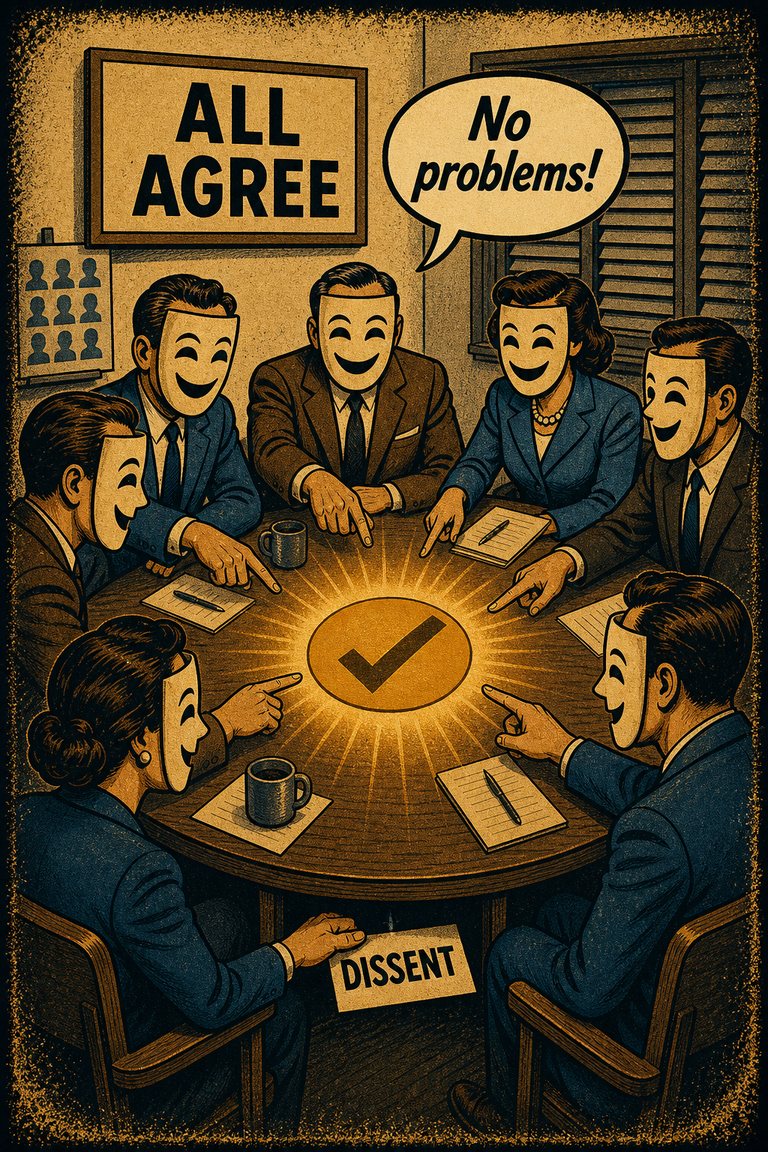
The tendency for groups to protect harmony or momentum at the cost of critical evaluation and dissent.
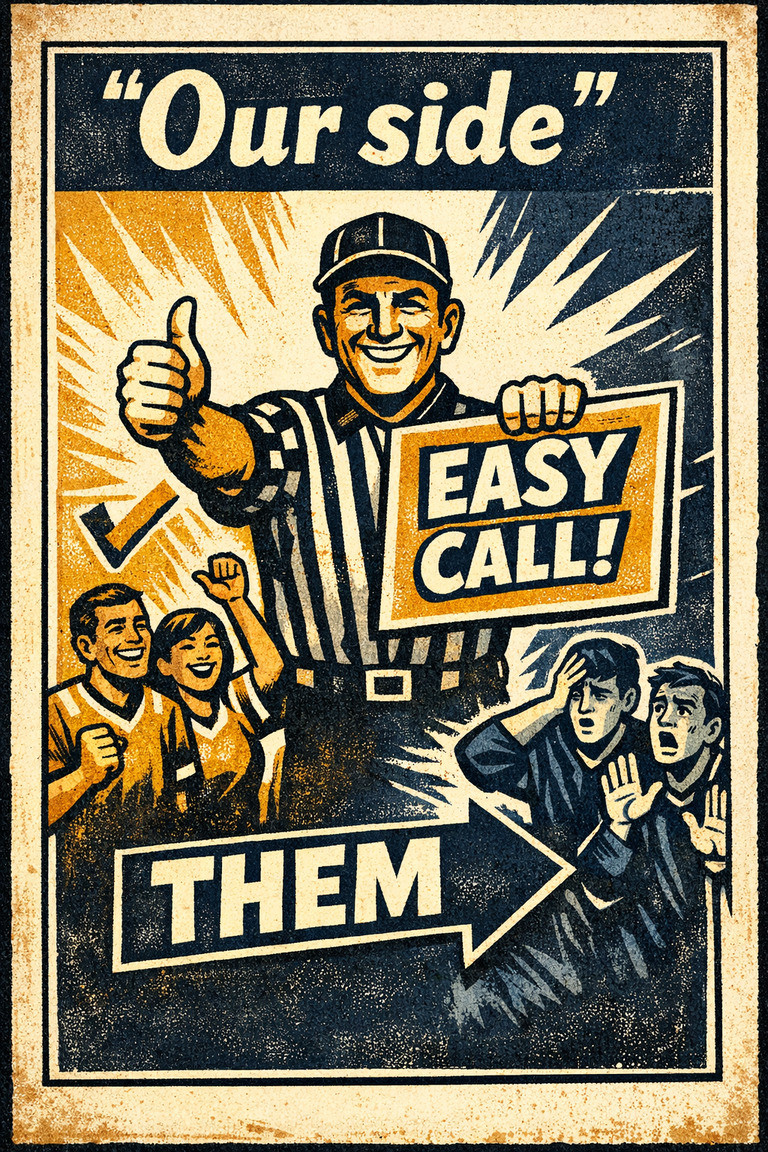
The tendency to favor, trust, defend, or positively interpret people and claims associated with one's own group more readily than comparable outsiders.

The tendency to see one's own view as plain reality and disagreement as ignorance, bias, or irrationality.
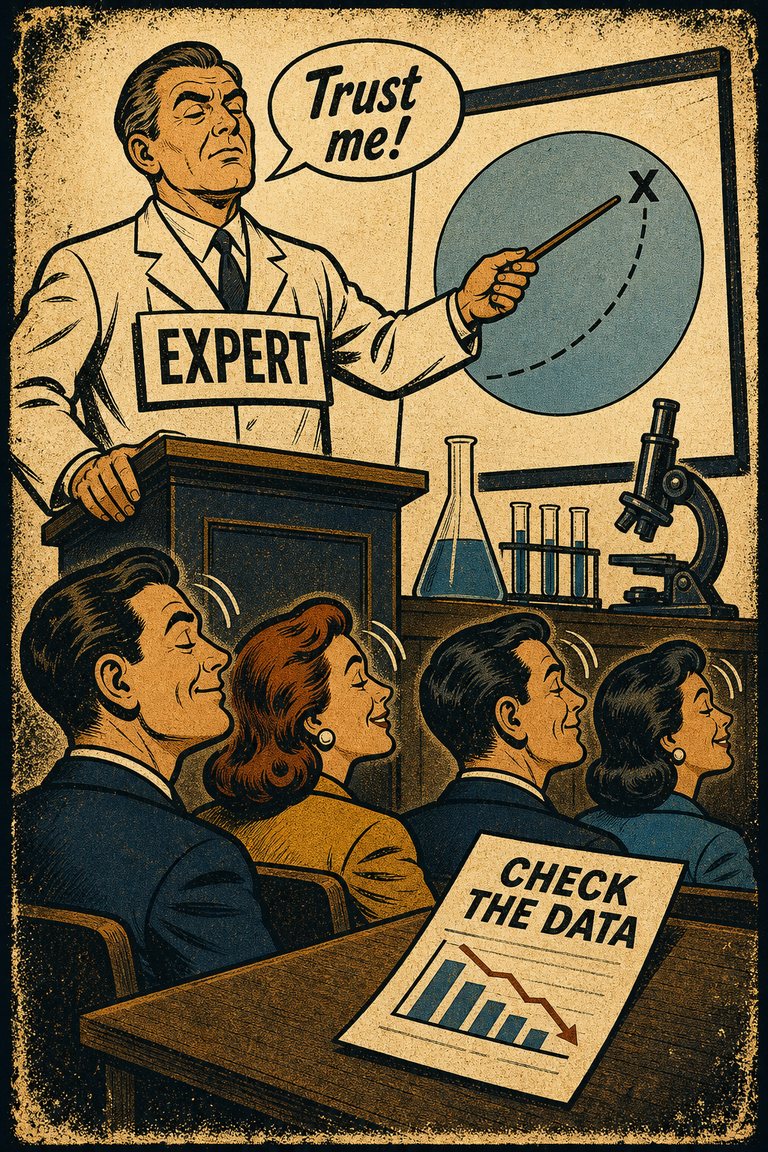
The tendency to give excess weight to the opinion of a high-status or authoritative source independent of whether the source has earned that weight on the specific issue.
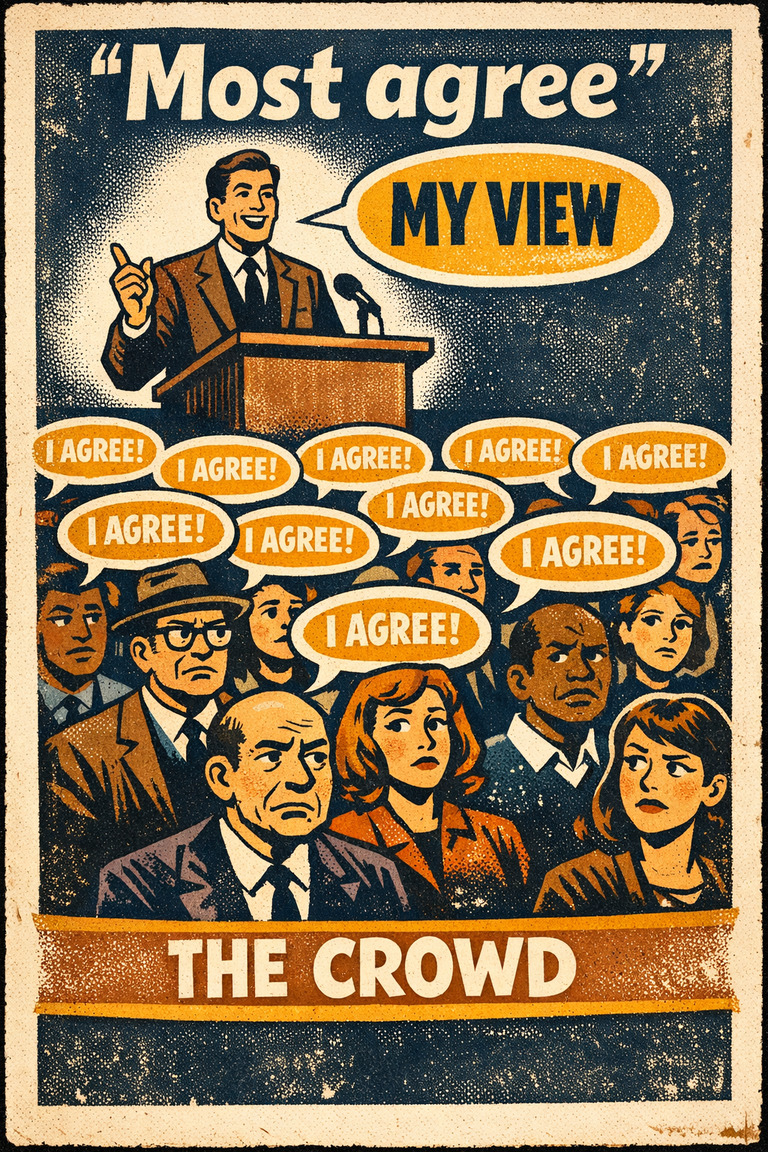
The tendency to overestimate how many other people share one's own beliefs, preferences, habits, or reactions.
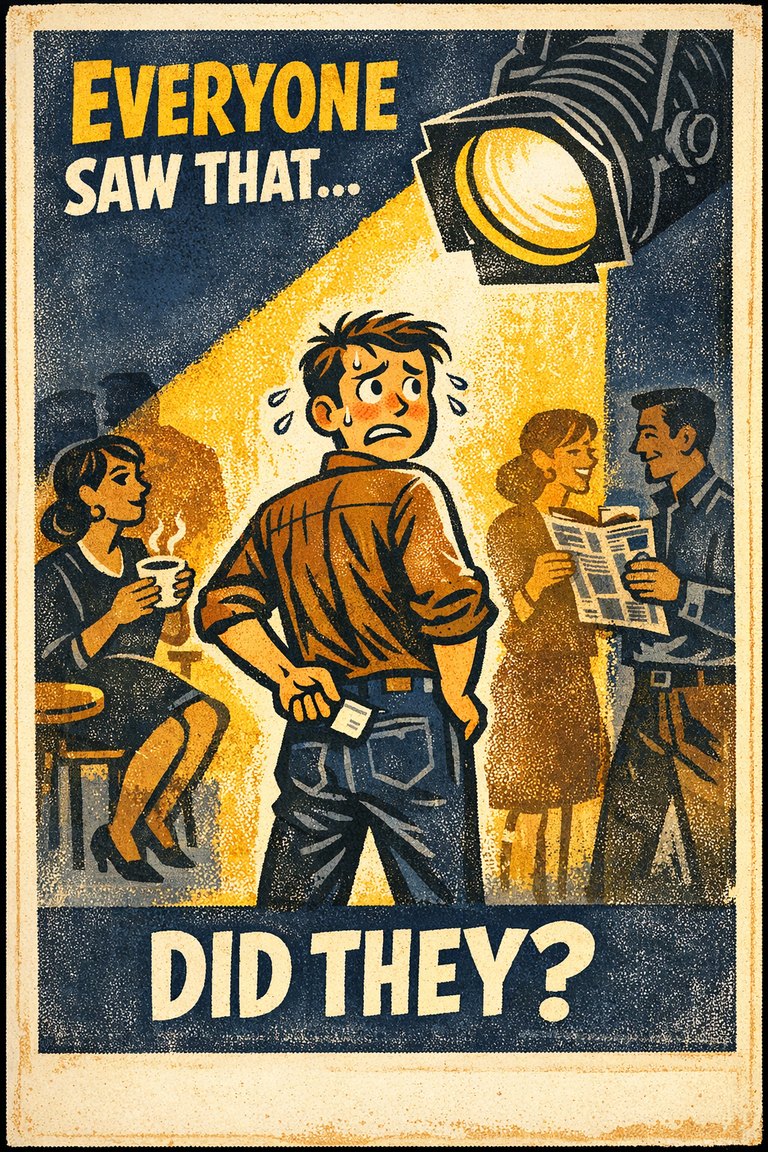
The tendency to overestimate how much other people notice, remember, or care about one's appearance, mistakes, or behavior.