Common in live judgment
88
Very common in teaching, onboarding, writing, and product design.
Rare
Frequent

Cognitive Biases
A practical cognitive-bias site with clear definitions, learning paths, assessments, self-audits, and debiasing tools.
Cognitive Bias
The tendency for informed people to underestimate how hard it is for less-informed people to follow or predict the same material.
What it distorts
It bends teaching, communication, onboarding, and forecasting about what others can understand or notice.
Typical trigger
Expert explanation, onboarding, product design, writing for novices, and any situation where perspective-taking has to cross a large knowledge gap.
First countermove
Ask what a thoughtful novice would still be missing at each step of the explanation.
Best use
Structured process
What feels obvious to me only because I already know it?
Once knowledge is internalized, it becomes difficult to simulate ignorance accurately. The informed mind loses access to how many steps, definitions, and hidden assumptions used to be non-obvious.
These are classroom-facing editorial estimates for comparing how the bias behaves in use. They are teaching aids, not measured statistics.
Common in live judgment
88
Very common in teaching, onboarding, writing, and product design.
Easy to spot from outside
44
Most visible when experts think they were clearer than their audience experienced them.
Easy to innocently commit
91
Knowing the answer makes the missing steps hard to feel from inside.
Teaching difficulty
47
Simple to define, but deeply sticky in practice.
This comparison makes the hidden pull easier to see before the technical label has to do all the work.
Biased move
This is like reading the answer key first and then forgetting what the question looked like before the answer was visible.
Clearer comparison
Once the solution is in view, the path to it compresses. Good explanation work has to reconstruct what the world looked like before the knowledge arrived.
Do not use this label every time an expert explains badly. Sometimes the explanation really is careless. The issue here is the perspective gap created by knowing too much to simulate not knowing well.
Use this label when informed people underestimate how much context, sequence, or translation less-informed people still need in order to follow the explanation.
Use the quick check, caveat, and nearby confusions together. The fastest diagnosis is often the noisiest one.
Each example changes the surface context while keeping the same hidden distortion in place.
Someone explains a process in a way that sounds clear to them but quietly skips the very steps a newcomer would need.
An expert team ships instructions, dashboards, or documentation that presume far more shared context than new users actually have.
Well-informed commentators speak as though the missing background is trivial, which makes less-informed audiences appear more unreasonable than they really are.
The explanation feels straightforward, so the other person's confusion can start to look like inattention rather than like a real perspective gap.
Teaching note: This page gives CogBias a strong instructional voice because it explains why experts so often communicate badly without intending to.
The strongest debiasing moves change the process, not just the label.
Pressure-test your explanation on someone with less context or rewrite it for a thoughtful beginner.
Have newcomers or adjacent teams review documentation before assuming it is clear enough.
Build novice checks into education, onboarding, and product writing instead of treating expert fluency as the default audience.
Practice And Repair
The curse of knowledge compresses explanation. Once the structure is visible to you, it is hard to remember which parts were once invisible, counterintuitive, or expensive to infer.
A knowledgeable person has to explain, predict, or design for someone who lacks the same background.
The explanation feels straightforward because the person can no longer feel the original uncertainty or missing links.
Critical context, sequence, or translation steps get dropped, and the audience's confusion looks more like inattention than like a real perspective gap.
Reconstruct the first missing step, not just the finished concept, and test the explanation on someone who does not already share the map.
What does the listener need to know one step earlier than I am currently assuming?
Spot It
Slow It
Reframe It
These are nearby labels that can share the same outer appearance while differing in what actually drives the distortion. Use the overlap, the distinction, and the diagnostic question together before settling the call.
Why compare it: Illusion of explanatory depth is about overestimating how deeply you understand something; curse of knowledge is about underestimating how hard it is for others to understand it.
Why compare it: Dunning-Kruger concerns miscalibration from low skill; curse of knowledge concerns perspective-taking failures once knowledge is already present.
Why compare it: False-consensus effect overestimates shared beliefs or reactions; curse of knowledge overestimates shared background and ease of comprehension.
These are useful when the label seems roughly right but the process change still feels underspecified.
What do I now take for granted that a novice would still need spelled out?
Which step in my explanation would have confused me before I learned this?
Am I judging the audience's attention fairly, or am I underestimating the knowledge gap?
These sourced cases do not prove what was in someone's head with perfect certainty. They are teaching cases for showing where the bias pressure becomes visible in practice.
The tappers-and-listeners demonstration
People tapping out a tune often wildly overestimate how recognizable it will be to listeners because the melody is vivid in the tapper's own head.
Why it fits: Knowing the answer collapses how large the listener's perspective gap seems.
Modern communication research
Experts write for novices as if key steps were obvious
Teachers, product designers, and subject-matter experts often skip intermediate steps because once they know the structure, it becomes hard to imagine what it feels like not to know it.
Why it fits: Possession of the knowledge compresses the apparent distance between expert and novice.
Modern communication research
Informed sellers struggle to model uninformed buyers
Camerer, Loewenstein, and Weber showed that people with privileged information often fail to adjust enough when predicting what less-informed others will infer.
Why it fits: Knowing the answer makes the ignorant perspective harder to reconstruct.
Journal of Political Economy · 1989
These linked tools turn the page into practice instead of leaving it at the level of definition.
This bias appears directly in one guided sequence and also in nearby paths that frame the same judgment problem from a slightly wider angle.
Direct path
Use this path when someone sounds sure, fluent, or experienced and you need to know whether the underlying understanding is actually there.
Nearby path
Use this path when a room feels aligned too quickly or when private judgment is likely being bent by social cost.
These audits combine direct and nearby checks so you can test the label itself and the broader judgment pattern around it.
Direct audit
Do I really understand this, or has fluency outrun competence?
Nearby audit
Would I still hold this view if I had to write it down alone before hearing the room?
These workshop packets mix direct coverage with nearby classroom material that makes the same distortion easier to teach.
Direct workshop
Confidence vs Understanding Classroom Kit
A lesson for showing how fluency, confidence, and real transferable understanding come apart.
Nearby workshop
Relationship Conflict Attribution Reset
A reflective kit for slowing motive-reading, character verdicts, and self-protective memory during conflict.
2 mixed scenarios let you diagnose this bias from the case rather than the heading.
Direct scenario
The missing bridge in the expert explanation
A teacher says a step in a proof is obvious and moves on, but several students are lost because the skipped step depends on background knowledge they do not yet have.
Direct scenario
The expert skipped the missing steps
A senior engineer explains a workflow to new teammates, then gets irritated when they still look lost because the explanation felt perfectly obvious to him as he gave it.
These links widen the frame around the bias without interrupting the core lesson on this page.
An article on how recognition and smooth explanation often get mistaken for depth long before the underlying competence is there.
CogBias theory
A practical article on why fluency, familiarity, and articulate recall can look like mastery long before deeper understanding is present.
CogBias theory
These neighbors were selected from shared categories, shared patterns, and explicit editorial links where available.
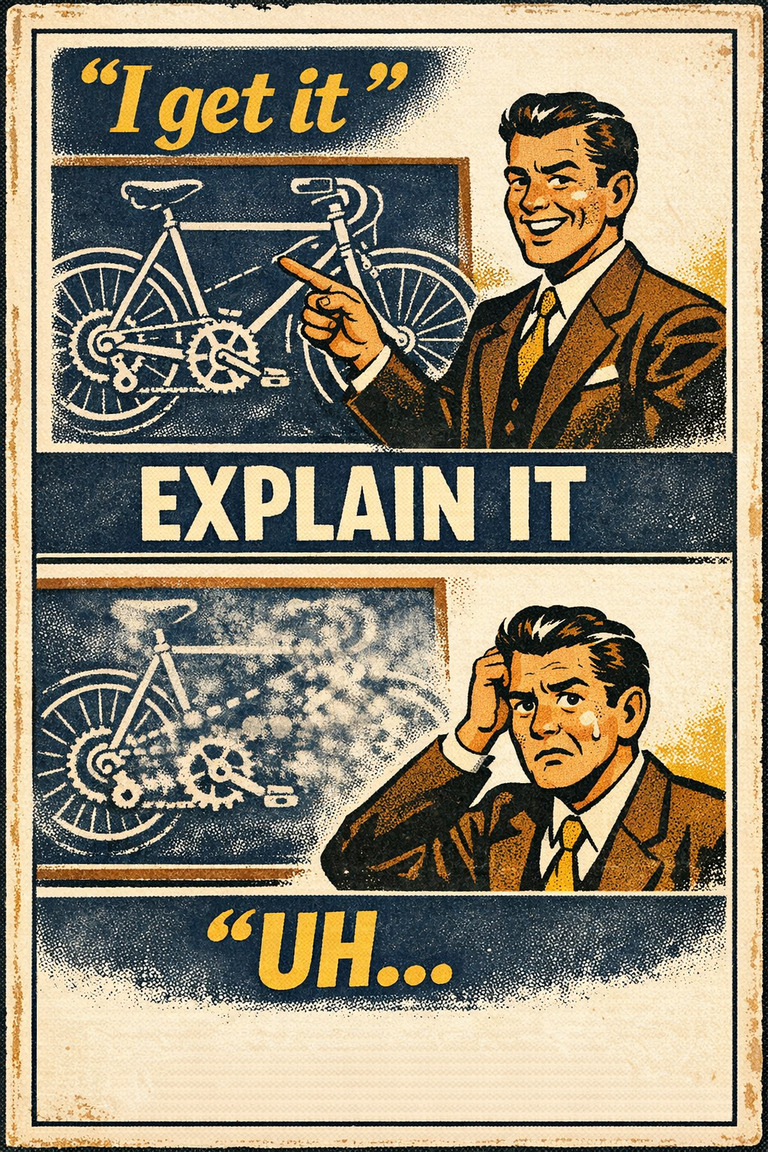
The tendency to believe you understand how something works more deeply than you actually do, especially until you are forced to explain the mechanism step by step.

The tendency for low skill or shallow understanding to produce overestimation of one's own competence, while higher-skill people may underestimate how unusual their competence really is.
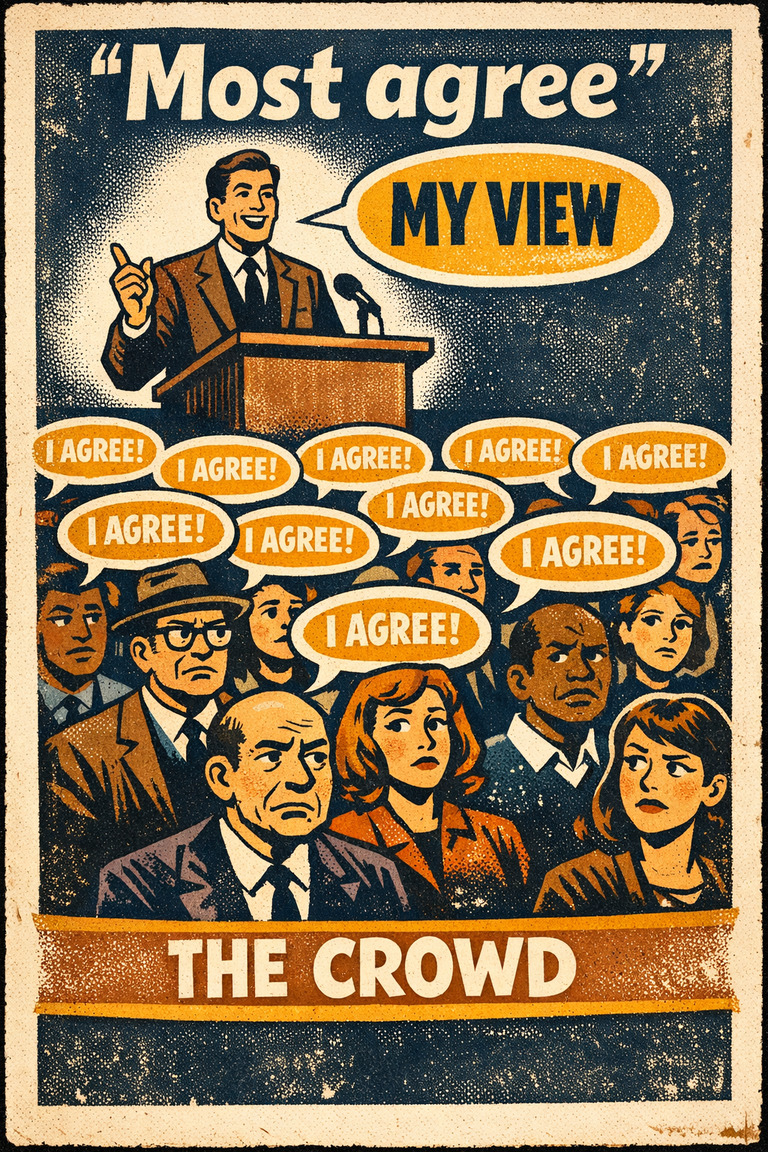
The tendency to overestimate how many other people share one's own beliefs, preferences, habits, or reactions.

An exception to the fundamental attribution error, where people view others as having extrinsic motivations, while viewing themselves as having intrinsic motivations.

The tendency to overestimate how visible one's thoughts, feelings, or intentions are to others.
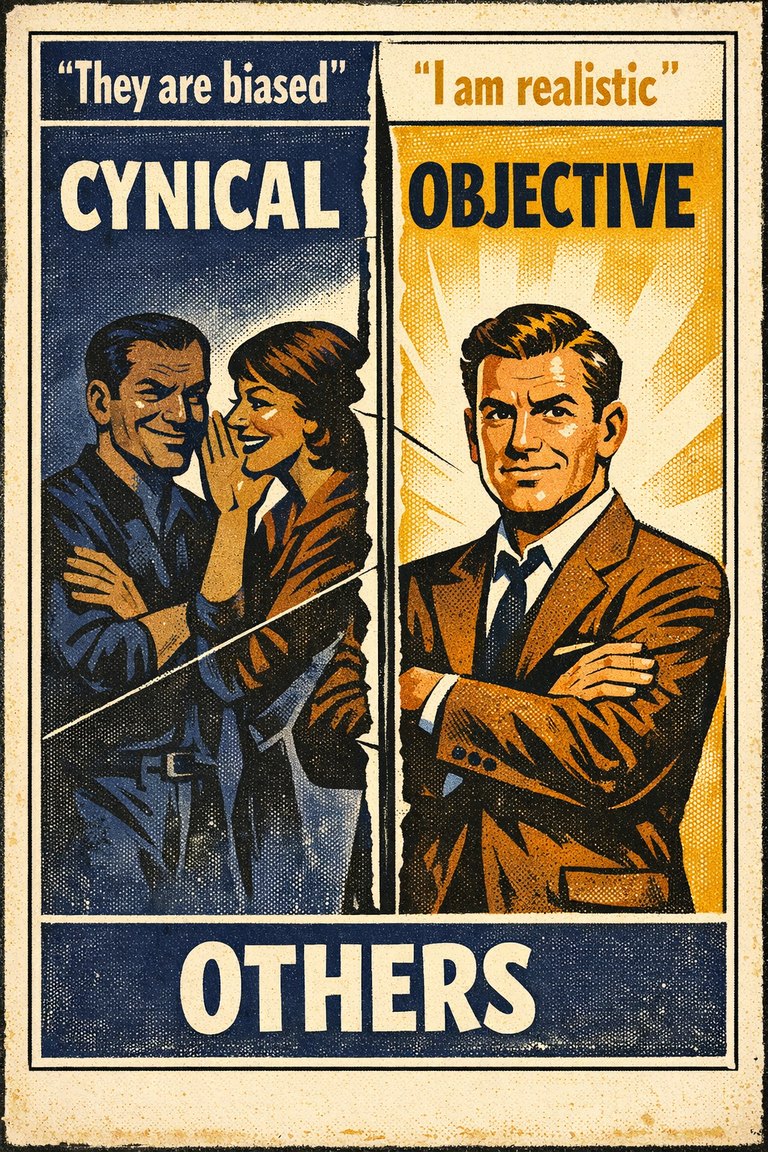
The tendency to expect more egocentric bias in others than in oneself.