Illusion of explanatory depth
Core pattern
People feel they understand how something works until asked to explain the causal steps.
Ask: Can the person produce the mechanism without relying on recognition?

Cognitive Biases
A practical cognitive-bias site with clear definitions, learning paths, assessments, self-audits, and debiasing tools.
Compare Biases
Illusion of explanatory depth is overestimating how well you understand a mechanism; Dunning-Kruger is miscalibrated self-assessment when limited skill hides what is missing.
Illusion of explanatory depth
People feel they understand how something works until asked to explain the causal steps.
Ask: Can the person produce the mechanism without relying on recognition?
Dunning-Kruger effect
Low skill can come with inflated self-assessment because the person lacks the skill needed to notice gaps.
Ask: How does self-rating compare with performance on representative tasks?
Both can produce confident beginners, especially when the learner has not yet faced a real performance test.
Ask whether the missing piece is mechanism explanation or broader competence calibration.
Use these before deciding which label should carry the lesson.
Is the test an explanation of a mechanism or a performance benchmark?
Does confidence drop when the person must explain steps?
Does confidence remain high despite poor task performance?
The same surface area can point to different underlying mechanisms.
Someone cannot explain how a zipper works after saying it is simple.
Why: The failure appears when mechanism detail is requested.
A novice performs poorly but rates their skill near expert level.
Why: Performance and self-assessment are miscalibrated.
Repair Move
Pair mechanism explanation with a representative task and compare confidence before and after feedback.
Use the comparison as a bridge into the fuller pages.
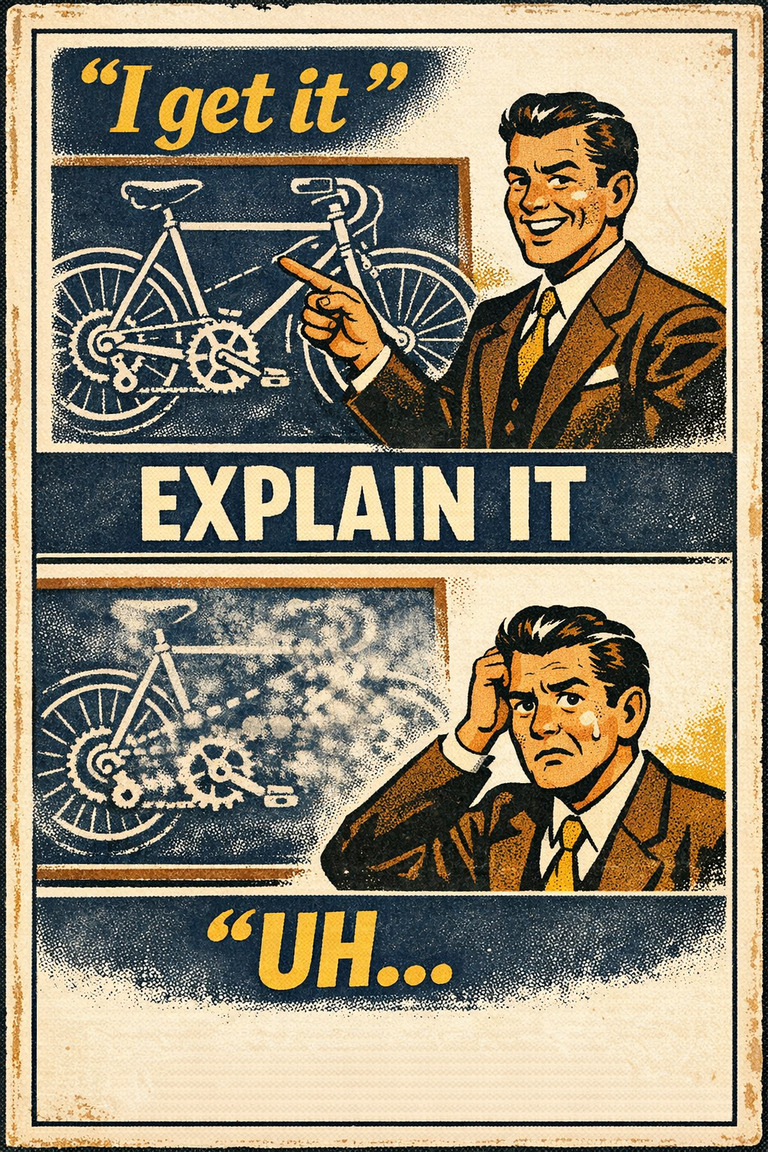
The tendency to believe you understand how something works more deeply than you actually do, especially until you are forced to explain the mechanism step by step.

The tendency for low skill or shallow understanding to produce overestimation of one's own competence, while higher-skill people may underestimate how unusual their competence really is.